Nov 11, 2017
I'm moving!
Please visit my new home at phool4XC.vivaldi.net. I will preserve the content already posted here, but comments will be disabled as soon as I figure out how.


Sep 6, 2017
Peter the Pilgrim

The Areopagus Podcast is hosted by Fr. Andrew Stephen Damick, an Orthodox Christian priest, and Mike Landsman, an Evangelical Christian pastor. Fr. Andrew and I first met in 2004 as students at St. Tikhon's Orthodox Theological Seminary, although we'd made contact online before then. I was their guest for the latest episode, talking about pilgrimage. (I was introduced at 12:45 into the 98 minute long episode.) I didn't say much about any of my big pilgrimages in particular, but the general discussion may still be of interest. The episode can be downloaded from the site, streamed online, or you can subscribe to the podcast series and download it that way.
Aug 29, 2017
Coming soon to a podcast near you!
I had a great time with Fr. Andrew Stephen Damick and Pastor Mike Landsman this afternoon, recording an episode on pilgrimage for The Areopagus podcast. (It'll take some time for Ancient Faith to work their production magic on the raw recording. Watch this space!)
I'd hoped to mention this book, but couldn't work it in. The Road to Emmaus: Pilgrimage as a Way of Life is a great book about how to live life as a pilgrim. There are chapters about traditional pilgrimage, with anecdotes from the author's experience, but there is also insight on how to be a pilgrim in daily life. Dorothy Day, Thomas Merton, Hilaire Belloc and others are quoted throughout.

Feb 18, 2017
'Alternative Facts'
The most striking difference between ancient and modern sophists is that the ancients were satisfied with a passing victory of the argument at the expense of truth, whereas the moderns want a more lasting victory at the expense of reality. In other words, one destroyed the dignity of human thought whereas the others destroy the dignity of human action. The old manipulators of logic were the concern of the philosopher, whereas the modern manipulators of facts stand in the way of the historian. For history itself is destroyed, and its comprehensibility - based upon the fact that it is enacted by men and therefore can be understood by men - is in danger, whenever facts are no longer held to be part and parcel of the past and present world, and are misused to prove this or that opinion.
- Hannah Arendt, The Origins of Totalitarianism
Aug 6, 2016
St Gregory Palamas' Homily on the Transfiguration
After Pascha, the Feast of the Transfiguration is my favourite festival of the ecclesiastical year. Here's a homily on the subject by one of the greatest preachers and teachers of all time.
St Gregory Palamas' Homily on the Transfiguration
St Gregory Palamas' Homily on the Transfiguration
Jan 30, 2016


Apr 24, 2015
Home Sweet Home
I forgot to ask my family to bring a Tim Horton's coffee with them when they come to pick me up from the airport, but it doesn't matter. Twenty-one hours after I woke up in Amman, I am back in Canada!
Purgatory
This theological concept arose in the mediaeval western church, being neither heaven nor hell, but a place where the souls of the deceased stay until they have suffered in recompense for their sins, at which point they are released to their heavenly reward. (I've probably misrepresented the doctrine, but oh well.)
My loathing of airports increases whenever I am forced to spend time in one. Well actually, the Queen Alia International Airport in Amman was "not bad," but as a transit hub, Heathrow Airport in the UK has nothing but gross commercialism to "recommend" it. The good news is that I will be able to breathe fresh air again in another ten hours, but between now and then I will be simply trying to refrain from screaming. I have not been confined indoors for this length of time in... well, I don't know. Years? Decades?
If I ever leave North America again, I owe it to myself to investigate the option of shipping out on a "tramp steamer" -- if those still exist. Or, I suppose, pay triple or quadruple the price for a direct flight.
Long Day Ahead...
I don't even want to think about the day ahead of me, but I now have my boarding pass and have cleared all the security checks at the Queen Alia International Airport in Amman. Now it's a matter of sitting and waiting and sitting and more sitting. It's hard to believe my odyssey is almost over, but I'm ready to head home.
Apr 22, 2015
April 20 - 21: Nazareth

"I pulled into Nazareth, I was feelin' about half past dead
I just need some place where I can lay my head"
- The Band
I don't know why, but I am no longer as weather-resistant as I used to be. Each time I've been caught out in a cold rain without my poncho, I've wound up with a deep chest cough and sinus congestion that lasts several weeks. It happened in Turin, Durrës, Sofia, and most recently in Jerusalem. I've kept myself going with "cold and flu" tablets, but even with the chemical crutch, my endurance isn't what it normally is.
It was slightly past 11:00 Sunday night when I finally found the hostel I was looking for in Nazareth's Old City. My afternoon trip to the beach had been very therapeutic, but then I spent the next five hours scrambling from bus to bus. It shouldn't have taken the toll on me that it did, but I'd been awake since 6:00 and I was feeling moderately wretched. As it happens, the Fauzi Azar Inn locks the gate and shuts down their reception at 9:00. I'd been standing in the narrow lane beside the door for about five minutes wondering what to do next when two guests came back from a late dinner and let me in. Fortunately for me, the desk clerk hadn't left yet, so I was able to get a bed for the night.
I could have simply gone to one of a dozen other hostels and guesthouses in the area, but I'd really wanted to stay at this hostel. At Juha's Guesthouse in Jisr ez-Zarqa, they had spoken very highly of Fauzi Azar, and it is also the top pick for Nazareth in the Lonely Planet guide. (I know I haven't written about the days of walking between Megadim and Jerusalem, but I will! The problem I keep running into now that I've stopped walking is interesting people and good conversations are filling my evenings. It's a good problem to have!)
In spite of my exhaustion, I was up early Monday morning, well before my alarm. After breakfast, I took advantage of the free city tour offered by the hostel. Before it began, we were given a brief history of the house and how the hostel came to be. It's named for the patriarch of a Nazarene family who lived from 1903 - 1980. Fauzi Azar was the second (or third, I forget) generation to live In the house. The family had originally come to Nazareth from Lebanon and had prospered enough to build a mansion in the 19th century with cedar trim from the Taurus Mountains (in Turkey) and marble flooring from Marmara (likewise). The clay roof tiles were all imported from Marseilles, while the twenty foot high ceilings had been handpainted by an artist from Lebanon. In the latter part of the 20th century, the Old City went into a decline. Many of the homeowners left, leaving their homes locked up -- but still vulnerable to the criminal element which gradually moved in as the area ceased to function as a neighbourhood. When their mother passed away in 1989, the children had all married and moved away from the Old City, and none of them were interested in bringing their families to what was now a very bad part of town. The mansion sat vacant for the next fifteen years, used as a garbage dump, urinal, and party spot by drug dealers. Then in 2004, a young Israeli backpacking enthusiast approached the family with a proposition. After strong initial opposition, a lease was drawn up. No money was involved -- his "payment" was to clean up the property and keep the name of Fauzi Azar alive through the hostel. For more about the background of the hostel, Maoz wrote an article that was published in The Jerusalem Post in april 2008, republished here:
www.fauziazarinn.com/fauzi-azar-story/
2015 is the tenth year of operation for the hostel, but with the dramatic drop in tourism throughout Israel in the wake of last summer's war against Gaza, it came very close to shutting down.
The tour itself was not what I'd expected. All the other city walking tours I've gone on have given a general overview and introduction to the place, which I have used as a basis for my solo explorations. The hostel intends to be more than just a bed to sleep in -- the staff are all involved in volunteer community projects, some of which they have started. Because of this deliberate focus on the community, all of the stops on the tour were within a five minute walk of the hostel, and at almost all of them, the group was introduced to a local business owner who talked a bit about their specialty. It's a good idea, but after the fifth or sixth stop it became too much for me. As part of a group, there was no opportunity for direct one-on-one conversation with the people we were being shown -- and yes, it began to feel a little like a staged show. I knew I wouldn't be supporting these people by buying from them since a) I'm basically broke now and b) I have a very VERY small pack. At a neighbourhood coffee shop / gameroom (backgammon and dominoes), our guide announced that if anyone wanted, the remaining stops were optional. I was (still) tired from the long day I'd had Sunday and feeling worn down by the incessant flow of chatter by our "perky" American guide. I excused myself and enjoyed a leisurely coffee. I also had a chance to speak with the owner and one of his friends "off script," which was nice.
Feeling somewhat refreshed, I wandered off in search of the Orthodox Church of the Annunciation. The Catholic basilica was impossible to miss, what with the massive spire that looked like a cross between a hurricane lantern and a lighthouse. (That, and all the tour buses, which disgorged "pilgrims" on a frequent and regular basis.) I know it's wrong to judge by appearances, but the whole thing looked disconcertingly modern, with all of the excess that implies. I spotted a few street signs in Arabic and English that led me to a church that looked about right, but it was shut. It was also several blocks away from the location indicated on the tourist map I'd picked up at the hostel. A passerby eliminated my confusion when he told me it was the Coptic Orthodox church. A few more minutes of walking brought me to the "Greek" Orthodox site. (In the lands of the former Ottoman Empire, the Orthodox Church is referred to as "Rum Orthodox," i.e. Roman. The Ottomans knew which empire they had conquered, even if later European historians got confused. It was never called the "Byzantine" Empire.) The tour buses were much less frequent at this "traditional" site of the Annunciation, and for almost an hour there was nobody in the church except me and a church member. We got to talking a bit, in a mixture of Arabic and English. Nabil told me that they have Vespers every day at 4:15, "but not today" because of a funeral. They also have weekday Liturgies every Tuesday and Thursday at 8:00. After chatting some more, I took my leave and went in search of some long-overdue lunch. The burger joint I found is owned by a member of the church council, and while I was waiting for my food, we got to talking. He is very proud of the Christian heritage in Nazareth, but also very pessimistic about the future of Arab Christians in Israel. The systemic discrimination they encounter from the state and the open prejudice they face from both Jews and Muslims continues to drive the Christian exodus from their ancestral lands.
On returning to the hostel, I sat down on my bed and began sorting through my photos from the previous few days. Within five minutes, I was asleep. When I woke up after dark, I continued the task and then began uploading them. I decided that writing an update could wait for another day. Earlier in the day, I had been looking through the binder with bus schedules at the reception desk, and discovered I could catch a bus to Amman from Nazareth, without having to travel to Tel Aviv. A handwritten note at the bottom of the page indicated that as of 24/06/2012, these buses would run daily. Satisfied that I'd have one more day in Galilee, I decided to visit Mount Tabor on Tuesday and paid for a third night at the hostel. As the crow flies, the site of the Transfiguration of Christ is only 9 kms from Nazareth -- but taking that route would involve quite a bit of trespassing. The bus binder had a page with detailed instructions on how to get to Tabor by bus.
Tuesday morning after breakfast, I used the phone at reception to contact the bus company to book a seat for Wednesday morning. Guess what? The "daily" option only applies for the summer months - the rest of the time, buses to Amman run every other day, and Wednesday is not on the schedule. Suraida, a grandchild of Fauzi Azar, came to my assistance. She phoned a cab company and negotiated a fair price for me to be taken from Nazareth to the border crossing. It was three times as expensive as the bus would have been, but given the distance and time involved, it was the best solution available.
With all that sorted, I set out for Mount Tabor. Thanks to the info at the hostel, I knew which buses I'd need to catch, and (just as important) where to catch them. What I didn't know was when and how often they ran. I must have missed my first ride by a matter of minutes, because it was almost a full hour before the 356 came by. That took me to the bus station in Afula, where I was able to catch the 350 before it pulled out. Half an hour later, on our way through the town on the shoulder of Tabor, we passed another 350 heading in the opposite direction. "Aha!" I thought. "They run every thirty minutes." As we passed the road to the peak, the driver indicated it to me and let me off at the next stop. There was a small-ish parking lot there with half a dozen tour buses parked, and a small transit terminal where the people transferred from their coaches to passenger vans for the ride up. I decided to walk.
As I headed back towards the road, I noticed a trail leading off the road and uphill. When I investigated, I found a sign in Hebrew and English which identified this as a section of both the Israel National Trail and a local trail. It noted that the trail was intended for fit climbers only, and that people should have a hat and at least three litres of water. I had two litres in my daypack, but it was a relatively cool day. I'd left my walking stick at the hostel, but I had my Tilley with me. Onwards and upwards!
It was a beautiful hike, but they weren't kidding about the fitness level required. It was a very stiff climb, and the thought of making the return descent without my walking stick did not fill me with joy. I took the twisty turny switchbacked road back down -- probably three times the distance, but it didn't take all that much longer to walk. As I approached the main road again, I spotted a bus heading back the way I needed to go. Checking the time, I saw it was three and a half hours since I'd been dropped off. "Oh well, the next one should be along soon." There was a bus stop for the return trip just opposite the road access to Mount Tabor - no shelter or bench, but I knew I wouldn't be waiting long. [That's called "foreshadowing," kids. It's a literary device.] Thirteen minutes later, the next bus drove by, heading uphill. I didn't know how long the route continued beyond where I'd been let off, but it couldn't be far. Right? R-i-i-i-g-h-t.... On that route, at that time of day, buses run once per hour. Within Israel, it's possible to get pretty much anywhere by bus, and it's really quite cheap, but if a traveller doesn't have a schedule, it can become a good test of patience. (Except on the Sabbath, when buses don't run at all.) It was 8:00 pm by the time I got back to Nazareth -- the 18 km (as the crow flies) round trip had taken me nine hours, including my time on the peak. Earlier in the day I'd set aside the money I knew I would need for my journey to Jordan. On the way back to the hostel, I stopped at a restaurant for dinner and spent all the rest of my money. When I reached Jordan on Wednesday, it was with less than a shekel jingling in my pocket. (But that account will have to wait for later.)
Having regained some strength with a good meal, I resolved to sit down and write a decent update. When I arrived at the hostel, that plan died when I met a fellow Canadian who had been globetrotting for the past five months. We sat in the courtyard and talked for several hours before I finally excused myself and headed off to bed. And that was my last full day in the Holy Land. Stay tuned for my Jordanian journey!
Apr 20, 2015
Fauzi Azar Lobby
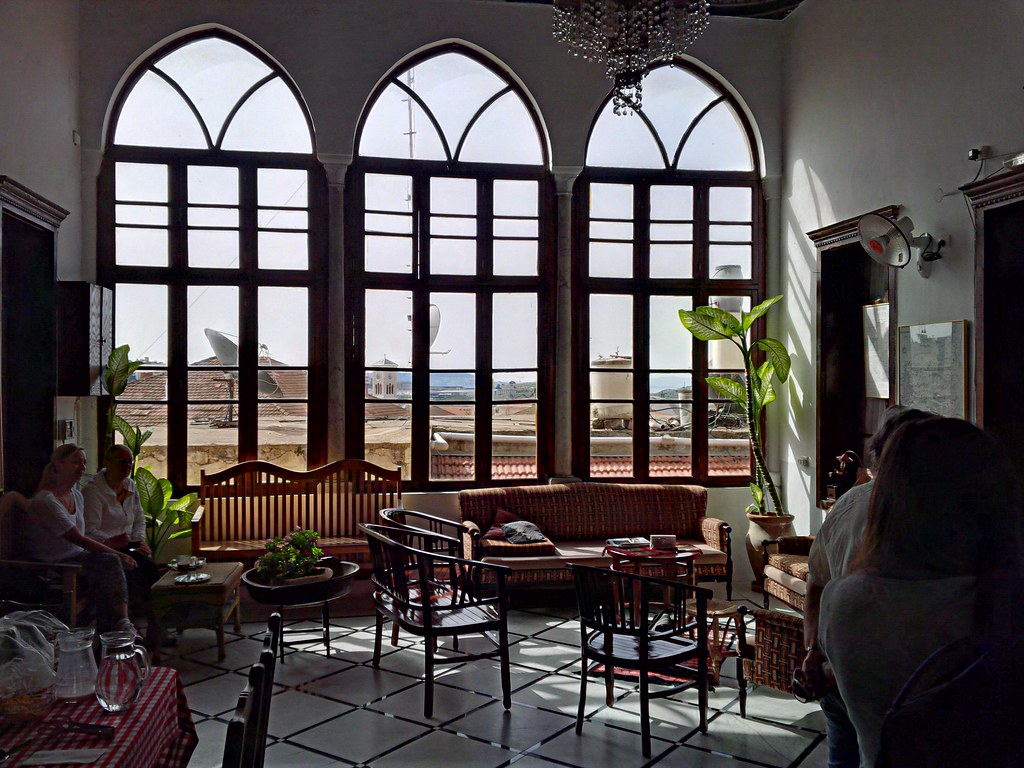
This hostel is set up in an Ottoman-style mansion with 15 rooms. The view is incredible, the courtyard has a fountain / koi pond, and it's only 90 shekels per night with breakfast. The really cool thing is, anyone with a Lebanese or Syrian stamp in their passport gets their first night free. Yup, that's me. :) http://flic.kr/p/sec8m6
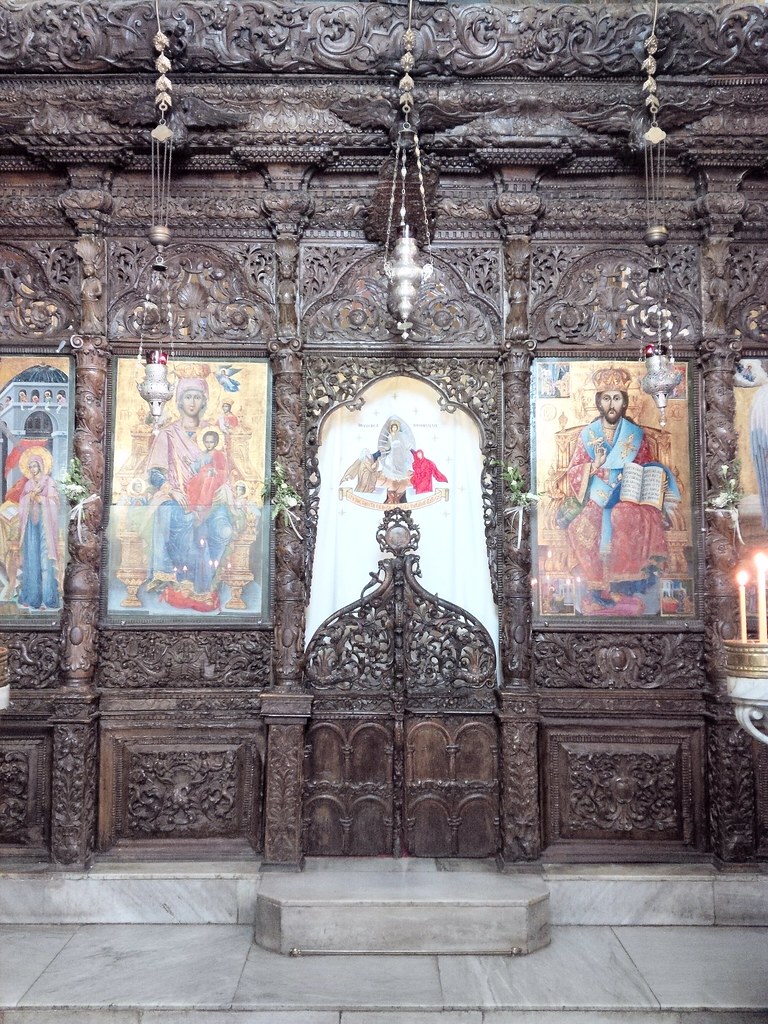
Iconostasis

The Church of the Nativity in Bethlehem. It was a little strange having all the scaffolding in place for repairs to the roof. http://flic.kr/p/rgehZu
Apr 19, 2015
My Last Sunday in the Holy Land

After Vespers yesterday afternoon, I walked around a bit and then headed back to the hostel. I said hello and chatted a bit with the new person at reception and then crawled into my bunk to write up the afternoon's excitement. Just as I was finishing up, Mousa tapped on the door to the room and said he was going to the market. I hit send on the message and went along with him. (I was the only person staying at the Bethlehem Youth Hostel last night, so he must have figured it would be okay to step out for a few minutes.)
On our return, we shared a meal together and got talking more. Mousa is an evangelical student at the Bethlehem Bible College. I didn't ask what his Catholic father and Orthodox mother thought of that, but he assured me he wasn't like some evangelicals -- he is convinced that non-evangelicals are Christians too. (I was quite gratified to learn that most of the students in the Biblical Studies department with him are actually Orthodox.) I doubt my finances will allow me to attend, but the Christ at the Checkpoint conference scheduled for 2016 is very intriguing.
christatthecheckpoint.com (This media-rich site works much better on a computer than a mobile device.) After verifying that I could leave my pack at the hostel and pick it up after Liturgy, I excused myself and began preparing for bed.
I slept well, and this morning I woke up a few minutes before my alarm. I was at the Church of the Nativity by 7:30 to find the chanters halfway through Matins. It was strange but neat to hear the service in Greek and Arabic. There was a brief pause at 8:00 when His Eminence Archbishop Theophylactos of Jordan entered the church, but by 8:30 the Liturgy had begun. Two hours later, we were done. When I tried to revisit the Grotto beneath the altar, I discovered there was an English language Mass being said in a side altar. The priests were performing the consecration of the Host, so I decided it was better not to intrude. Presumably the tour companies all know the church is off-limits Sunday morning, because I didn't see any groups. I'm not sure how many different sanctuaries there are on the site -- there's a large Franciscan church sharing a wall with the Orthodox church, and I believe the Armenians also have space there. The 19th century "status quo" agreement for sharing holy places is still in force, but the situation is much less confusing in Bethlehem compared to Jerusalem. Walking around town a bit I saw an Ethiopian monastery, a Coptic monastery, a Lutheran church, a Baptist church, and numerous Catholic churches.
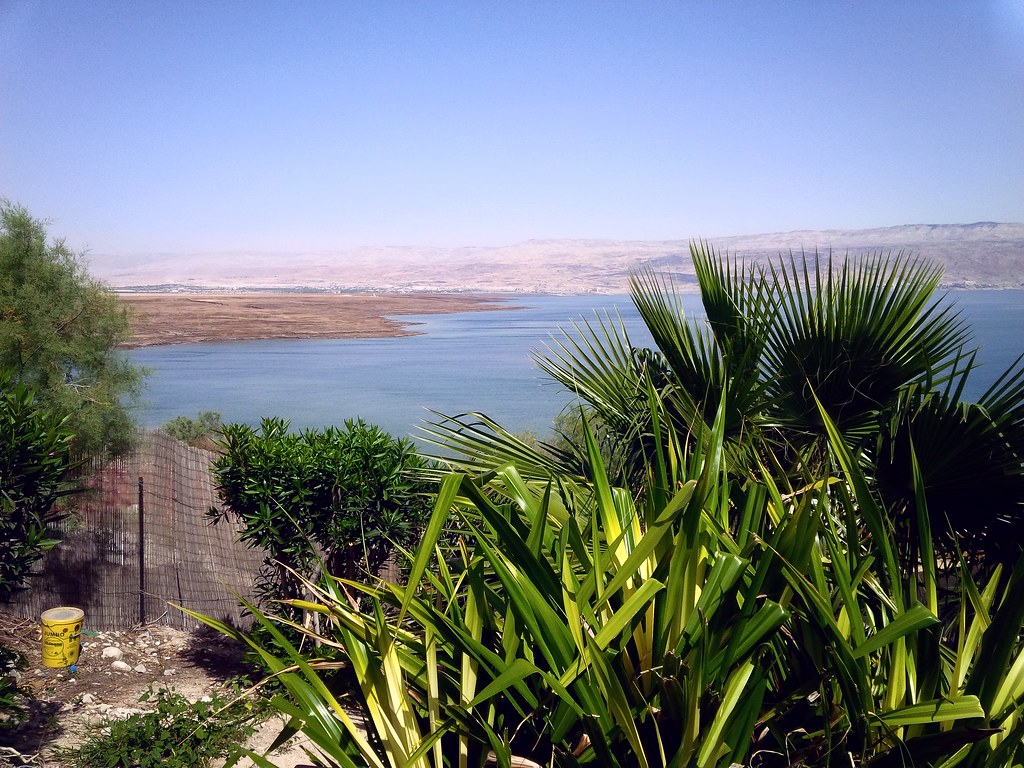
After a bite of breakfast, I started going over my travel plans for the day. I dropped the notion of visiting Mar Sabbas Monastery, in part because of the expense of hiring a taxi, but also because the subsequent walk to the Dead Sea through the Judean wilderness is very daunting. It's one thing to make plans in the comfort of the hostel, it's another to see the parched rolling hills shimmering in the heat and haze. Instead, I took a shared taxi ("sherut" in Hebrew, "servees" in Arabic) to Jericho. I ignored the archaeological riches in this 10,000 year old town, and went to the beach. I'm sure most people reading this are already aware of the geological oddities of the Dead Sea, but at 402 metres below sea level, you can't get any lower than this while still working on your tan. I successfully avoided sunburn by taking several short dips, followed by a freshwater shower and a spell in the shade sipping water. It was wonderfully relaxing! (Jericho will have to wait for another trip.) While I was there, I was surprised to hear someone calling my name. Without my glasses on it took a few seconds to focus, but there before me was one of the Chinese students I'd met at the hostel in Jerusalem on Friday. We didn't talk long, but the encounter left me with a smile on my face.
Three hours after I arrived, I was walking back to the highway. Another reason for skipping Mar Sabbas and Jericho is the transportation situation. Looking at a map of Israel and the Palestinian Territories, I had assumed I'd be able to hop a bus or servees north along Highway 90 from the Dead Sea to Tiberias, on the coast of the Sea of Galilee. I leaned today that this isn't possible. The only option from Jericho is a servees to Jenin, and then maybe a bus or taxi across into Israel. That seemed rather iffy, so I put my pack down on the bench of the first bus stop I came to on the highway. According to my Lonely Planet guide, it's possible to get to Jerusalem by bus relatively easily. There was no schedule posted, so I began rolling down my sleeves to protect my forearms from the setting sun. I'd finished one arm when a bus appeared, and it was even the one I needed!
The landscape in this part of the country is surreal. There is no flat surface anywhere, unless it's been bulldozed into existence. The hills aren't all that tall, but they are many. The winter often sees heavy rain which creates flash floods that roar through the otherwise dry creekbeds between the hills -- yes, it's possible to drown in the desert! Some of the tourist guides refer to this region as the Judean wilderness, while others call it the Judean desert. For many people, the word "desert" conjures up images of sand dunes and camels, but the tough rocky hills, general lack of moisture, and temperature extremes of this region all fit the bill. And this is where Christ spent 40 days fasting after his baptism. (On the outskirts of Jericho, there's a summit known as the Mount of Temptation, associated with that time in the life of Christ.) There's an image of Christ, very popular in some Christian circles, which depicts him gently knocking at a door, illumined by the light of the moon. He looks soft and sweet, and very very white. Let me tell you, anyone capable of surviving in this wilderness alone for 40 days (never mind fasting) is gonna be tough and brown -- kinda like a walnut, if that's not too disrespectful a comparison to make. Yet another reason for me to put my pudgy white body on an airconditioned bus to Jerusalem!
When I arrived at the bus terminal in Jerusalem, I made inquiries about transport to Nazareth. Apparently the only way to do it by bus is to first go to Haifa and then hop another bus from there. It's not that long ago that I was walking in the opposite direction, and now I'm cruising along in luxury back the way I came. The bus even had WiFi, although the much smaller one from Haifa to Nazareth did not. My (tentative) plan is to spend Sunday and Monday nights in Nazareth, Tuesday night in Tel Aviv, and stay in Amman Wednesday and Thursday nights. That will give me all day Thursday to visit Petra. As always, this is conditioned by the Lebanese IBM - Inshallah, Bukara, Min shuuf. (God willing, tomorrow, we'll see.)
Apr 18, 2015
How I Spent My Afternoon
Arriving in Bethlehem, I fired off the last update, mainly because I was feeling guilty about the long silence. After convincing the small coterie of taxi drivers which gathered around that I really did not need a taxi today, I headed uphill towards the Church of the Nativity. I stopped at the tourist office at Manger Square and picked up a map, and realised how close the Bethlehem Youth Hostel is to the church. I checked in and freshened up a bit and was inside the church by 2:00. It was both disappointing and encouraging to see the major renovations underway -- disappointing because there is scaffolding everywhere inside and the ceiling is completely covered, but encouraging because it means there's the money and the will to do major maintenance. The church was dedicated in 326 AD, and has been in continuous use as a place of Christian worship ever since. When the Persians arrived in the Holy Land in the early 7th century, they spared this church. Apparently, when they entered and saw the iconography of the three Magi, they recognised their own traditional garb. It may not be true, but it's a good story!
While I was admiring the iconostasis from a distance, I spotted a priest. I got his blessing in Arabic and then asked about the time for Vespers. I had just enough time to go have lunch at a nearby restaurant -- I had a smallish breakfast this morning and nothing since, not even coffee! When I returned back at church, I was just in time to see the bishop arrive and be greeted by the clergy. (I'm not sure who he is, but since he was only wearing one pectoral icon instead of three I'm pretty sure it wasn't the patriarch.) After the censing of the church during "O Lord I have cried," one of the deacons approached me and another man in the congregation, asked if we were Orthodox, and told us to follow him. He led us into the altar, and gave us each a large processional cross to carry in the entrance. For my non-Orthodox readers, this may seem like a cool thing but not really a big deal. My Orthodox readers, however, know what a privilege was extended to me today. After "Phos Hilaron," the deacon thanked us(!!!) and we returned to our places in the nave. Needless to say, I don't have the photos to prove all this -- it really wasn't an appropriate time for a selfie.
The pilgrimage may be over, but the experience keeps getting better and better!
The line to enter the Grotto of the Nativity was way too long for me, but I plan to be at church nice and early tomorrow morning, long before the tour buses from Jerusalem arrive. After Liturgy, I plan to take a taxi to Mar Sabbas Monastery, established in 439 AD. From there it should be a three or four hour walk to the Dead Sea, where I plan to camp for the night. I'll be carrying at least three litres of water with me, and I'll be walking with the sun behind me. (Or maybe I'll ask if I can spend the night at the monastery, and head east just before sunrise when it's still cool so that I arrive at the beach in time for a nice refreshing dip.)
Clearly, the last few days of my journey will be busy ones. I really don't know how much of this is even possible, but at this point it's all icing on the cake. As long as I'm at the airport in Amman by 8:00 Friday, I'll be happy.
April 18: Bethlehem Bound
The paucity of updates lately is due to the many interesting conversations I've had in the hostel the past few evenings. Instead of spending my time thinking and writing (both of which require solitude), I've been speaking with history students from China, a Messianic Jew from the US, a Muslim woman from the UK with a surprisingly syncretistic religious outlook, an American contractor based in Beer Sheva, an Argentinian backpacker... Their stories are as interesting as they are varied. Last evening I stayed up very late, sorting and uploading photos -- seven dozen of them, in fact.
This morning I finally found the Secretary of the Jerusalem Patriarchate in his office. His Grace +ARISTARCHOS stamped and signed my notebook, marking the "official" end to my pilgrimage. I'll probably continue to collect stamps right up until the time I leave, but I'm no longer "on pilgrimage."
As I type this, I'm on a bus bound for Bethlehem. The ticket cost 8 shekels, while the taxi driver who collared me as I approached the bus station had quoted 150. Yeah....
I hope to get to Vespers this evening and Liturgy tomorrow morning before resuming my journey. If it's possible, I'll visit the monastery of Mar Sabbas on the way to the Dead Sea. The weather forecast is hot and sunny, so if I can find relatively cheap transport, so much the better. According to the Lonely Planet guide, there's no problem at all with spending the night on the public beaches, and this has been confirmed by the staff at one of the hostels I've stayed at.
I had planned to leave Jerusalem much earlier than I did, since there is still so much I would like to see before I fly home, but I've worked out a tentative schedule that takes me to Bethlehem, the Dead Sea, Nazareth, Mount Tabor, Tel Aviv, Amman, and Petra. All of that before my flight leaves Amman at 11:10 Friday morning.
Just a few minutes after passing the "Arab Orthodox Sports Center" in Beit Jala, we arrived in Bethlehem. Time to find a hostel, dump my pack, and see the city!
Apr 17, 2015
Photos
Well, I didn't make it to Bethlehem today as planned, but I did finally take the time to sort through the photos I've taken over the past two weeks and start uploading. To view them as I post them, please visit
Flickr.
Flickr.
I've arranged them, and photos dating back ten years, in groups to make the viewing experience slightly less chaotic.
flickr.com/photos/phool4XC/sets
flickr.com/photos/phool4XC/sets
Subscribe to:
Posts (Atom)


 Posts
Posts

